Buying advice · 9 min. · By Vehilo ·
Configuring a new car: which equipment is worth choosing?
Start with the functions you will use
Build the configuration around the functions you need. Then check which trim, package or extra is required to get them, and compare the price of the complete car. An attractive option price is not the whole calculation if selecting it also requires a different trim.
Go to the configuration comparison worksheet
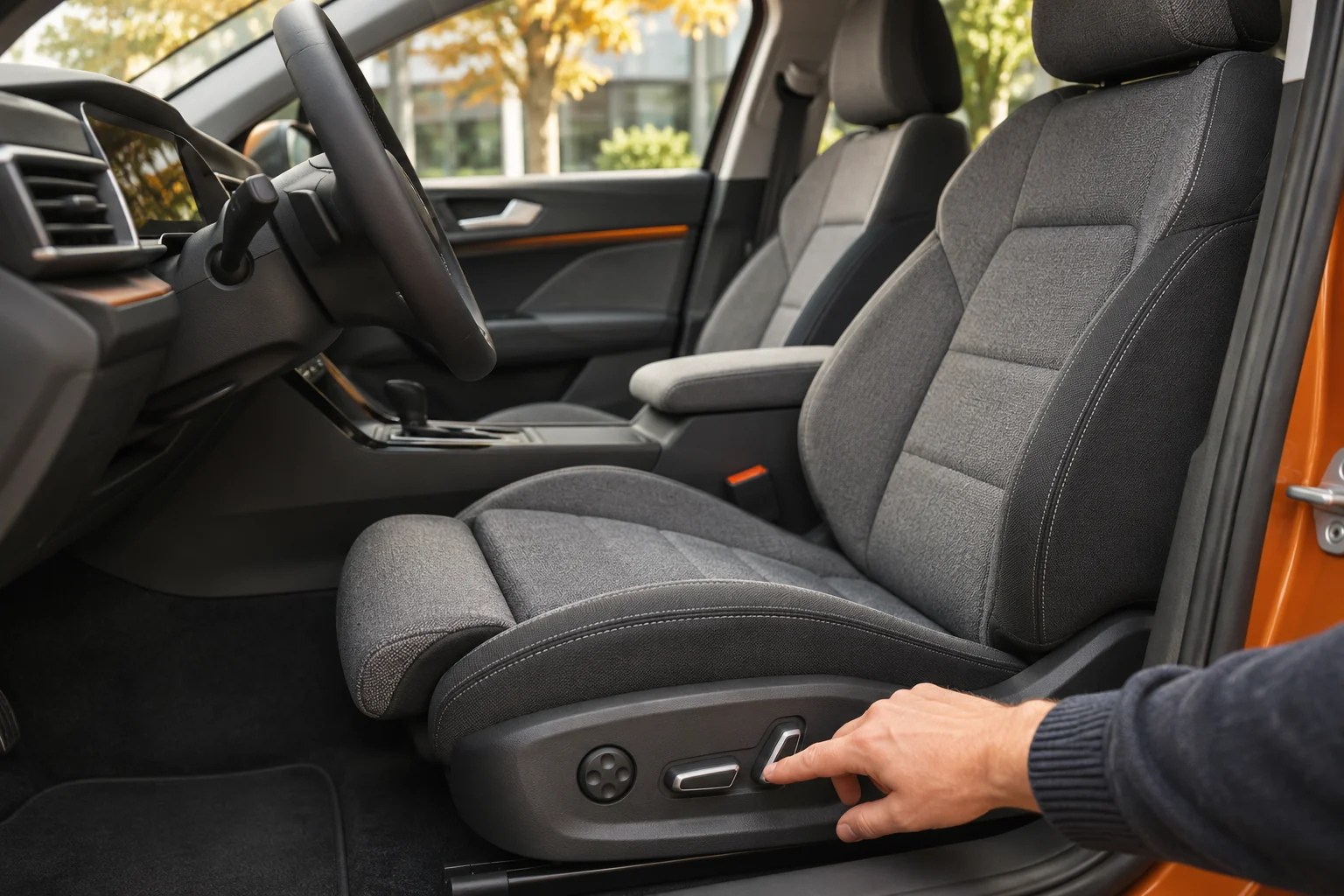
Illustration created for Vehilo with Image Gen on 5 November 2026.
You might care more about the engine and audio system than a panoramic roof or styling package. Someone else may choose differently. A package name should not decide those priorities for you.
The useful result is a configuration whose benefits you can explain, a traceable total price and a short list of things you still need to try in the actual specification.
Describe the job before choosing the equipment
A “comfort package” does not tell you what is missing from your daily drive. Write down the job the car needs to do.
| Need or preference | Question to resolve |
|---|---|
| Sit comfortably on longer journeys | Which seat suits your height and driving position? |
| Travel regularly with several people | Do seating positions, access and luggage work together? |
| Manoeuvre into a narrow driveway | Which assistance do you want, and how does it operate? |
| Enjoy listening to music | Which exact audio system do you want to hear and compare? |
| Charge regularly | Which charging equipment fits your locations and available time? |
| Enjoy a particular driving experience | Which engine and gearbox combination do you want to try? |
Use the daily-needs worksheet to separate essential, important, optional and unwanted features. A personal preference does not need an invented resale-value benefit to justify it. It can simply matter to you.
You can also leave an extra out, even when it is available or featured prominently in a package.
Save the first configuration that meets your needs
Choose the body style, powertrain, gearbox and equipment without which the car would not work for you. Save that version before adding preferences. It gives you a baseline against which each later choice has a visible cost.
Starting with the highest trim and removing a few extras makes it harder to see that baseline. For each addition, ask: is the function already included? Does it require another trim or package? Does it replace or exclude something already selected?
For a real car, use the German price list or configuration details for the exact version and model specification. Match the document date as well as the package name.
Real catalogue example: Golf Life with a seat package or Style?
You want an electrically adjustable driver’s seat with memory and adjustable thigh support. Compare the lower trim with the required seat package against the higher trim with those functions included.
The German Volkswagen Golf catalogue dated 2 March 2026 lists the following for the 1.5 TSI OPF, 110 kW (150 PS), six-speed manual. Base prices are on pages 23 and 31; seat equipment is on page 71. These are dated list prices, not current dealer offers.
| Catalogue item | Golf Life | Golf Style |
|---|---|---|
| 1.5 TSI OPF, 110 kW, six-speed | €33,890 | €36,575 |
| Specified driver-seat functions | €970 seat package | Standard |
| Calculated configuration subtotal | €34,860 | €36,575 |
| Difference from Life with seat package | – | €1,715 |
€33,890 + €970 = €34,860; €36,575 − €34,860 = €1,715. Do not add the separately listed €490 ArtVelours Eco interior package again: its stated upholstery and sports-comfort-seat content is already part of the €970 seat package.
The higher trim is therefore not required just to get those driver-seat functions. Decide which additional Style features would be worth the remaining €1,715 to you. The cars have other equipment differences, and a larger package does not prove that the seat will fit you comfortably.
VAT is included; the catalogue notes exclude delivery and registration. This is a calculation from the dated catalogue, not a completed configurator order. For an actual offer, confirm package combinations, availability and the full price. Another engine, gearbox or price date requires a fresh check.
A fictional example: calculate the full route to the equipment
This example is entirely fictional. It does not describe a manufacturer or a current offer.
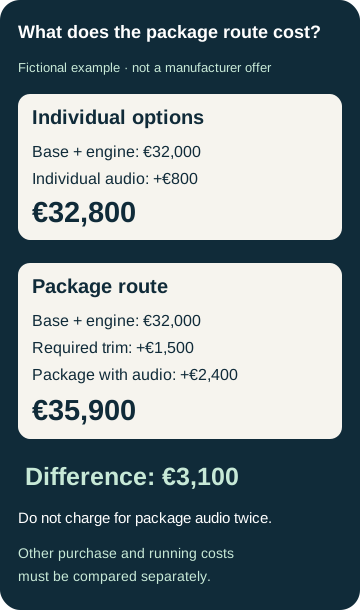
Both configurations include the same desired engine and audio system. Here, the audio system is available either individually or within a package. The package route also requires a higher trim and includes a panoramic roof and styling equipment.
| Fictional component | Individual options | Package route |
|---|---|---|
| Shared vehicle base | €30,000 | €30,000 |
| Desired engine | €2,000 | €2,000 |
| Audio system as an individual option | €800 | Included in package |
| Additional required trim upgrade | €0 | €1,500 |
| Package including audio and other equipment | €0 | €2,400 |
| Configuration total | €32,800 | €35,900 |
The difference is €35,900 − €32,800 = €3,100. It is neither just the €2,400 package price nor the package price plus another charge for the audio system. Audio is already included on the package route.
Both cars meet the stated preferences, but their equipment is not identical. Whether the additional features are worth €3,100 to you is a separate decision. This calculation covers the configuration; other purchase and running costs are outside it.
A package can still be the right choice
A package can make sense when you want several of its features or when the equipment is genuinely unavailable through another route. Compare the complete configurations that can actually be ordered. A theoretical individual option that the manufacturer does not offer is not an alternative.
You may be happy to accept an extra feature you do not care about. The decision changes if it includes something you actively dislike or takes the car beyond a firm budget. Ask what the full suitable configuration costs and what the additional money buys you.
Try the specification you intend to buy
A drive in the same model range does not answer every question about your configuration. Record differences between the demonstrator and the intended car. Seats, roof design and gearbox can matter to the experience you are trying to assess. Carry over an impression only where the relevant specification matches.
Set the seat to your driving position. Bring the child seats or largest luggage item you regularly use. Try the important controls. If audio matters to you, listen to the exact system you are considering.
Anything you could not try in the intended specification stays open. A good experience in a differently equipped demonstrator does not establish how the missing version will feel.
The documented manual-versus-automatic sports-car comparison, in German illustrates why the engine and gearbox need to be considered together. It is not a current order list for your configuration.
Keep the decisive details together
Save more than a price or configuration code. Keep the details you will need when comparing another version or written offer.
| Check | Your note |
|---|---|
| Vehicle | Model, body style, powertrain, gearbox and model specification |
| Required functions | Which needs must this configuration meet? |
| Selected equipment | Exact names and contents |
| Dependencies | Required trim, packages or other options |
| Still untested | Which seating, space or control question remains open? |
| Price basis | Date, configuration total and separately stated additional amounts |
| Comparison | How does this differ from the other configuration? |
Start a later offer comparison with these differences. A lower price is difficult to assess if it also means another engine, a missing feature or a different price condition.
For serious contenders, ask for an itemised equipment list and a matching written price offer. This worksheet prepares that comparison; it does not review the legal terms of a purchase contract.
Include the first year in your budget
The structure in the first-year car budget guide is useful here too: put purchase-related payments, other expenses and their due dates together.
Use amounts relevant to the new car rather than copying the used-car example. These may include delivery, registration, insurance, energy, accessories and upcoming maintenance. A particular cost may not apply to every purchase or fall within the same period.
Keep an unused reserve separate from payments already expected. Depreciation is a separate view of cost; do not add it as another bill on top of the full purchase price. Leave missing amounts open.
A configuration that exceeds your budget does not become affordable because each extra looks inexpensive on its own.
Know when the configuration is ready for a decision
You can explain which functions you need and which you chose for enjoyment. All necessary package dependencies are included, and you know how the other configuration differs.
You also know what you tried in a matching car and what remains untested. Save that version with its open questions so the next conversation starts from a clear comparison.
The manufacturer example is a reading of a dated German document, not a live offer. The separate €32,800/€35,900 example is fictional. Prepared with AI assistance; Vehilo did not order or test a car for this article.