Buying advice · 12 min · By Vehilo ·
Private used-car contract in Germany: Before you sign
A private used-car purchase is easier to organise when you prepare the contract before collection day. First establish that the car, seller and promised features belong together. Then agree on the price, payment method and handover. Signing a document with unanswered fields does not supply missing evidence.

For a private used-car contract in Germany, follow a clear order: collect the details, resolve contradictions, view the car and then read the final agreement. Pay particular attention when someone sells for the owner, finance is outstanding or important repairs are described only in conversation.
Vehilo helps you prepare your car purchase by organising requirements, offer details and open questions for the next decision. This guide explains what to assemble for a private purchase in Germany. It deliberately provides no newly drafted legal clauses to sign without checking.
Prepare the contract before the appointment
Establish the seller's authority
Record statements, damage and repairs
Understand private-sale liability for defects
Read the contract beside the evidence
Coordinate payment and handover
Prepare registration, insurance and vehicle tax
Prepare the contract before the appointment
Ask for the proposed contract early. You can then read which details have been entered and which are missing without rushing. A form supplies the structure. What matters is what the parties actually agree for this vehicle and which documents support the statements.
Keep the advert, messages, vehicle details, service records and open questions together. Save the advert with its date. If the seller changes a statement later, you should be able to see what information was available at each stage. This helps you compare the records; it does not automatically establish the legal effect of a particular sentence.
Write your essential requirements beside them. The required seats, gearbox, towing capability or charging equipment need to be established before the contract. A carefully completed agreement cannot make an absent feature suitable. If the car demonstrably fails your needs, another candidate is the more useful direction.
Allow time for a viewing, test drive and suitable professional inspection. Build the inspection brief around your unanswered questions. A noise needs a different investigation from a missing invoice. Do not let a contract already printed for you push those steps out of the process.
Put unresolved points in order of importance. Identity and authority to sell come before any payment commitment. Whether your luggage fits is a question for the viewing. A technical concern needs a specific professional assessment. This sequence avoids organising an appointment for a car whose basic purchase arrangements remain unclear. Ask for a named document or a particular check instead of waiting for a general assurance that everything is fine.
Match the car to its records
The vehicle identification number, or VIN, connects the advertised car to its documents. Compare it on the vehicle, in its German registration certificates and in relevant records. Also note the model, exact version, first registration, registration number and odometer reading observed at the viewing.
Separate the displayed odometer reading from any promise about total distance travelled. A plausible sequence of service entries helps, but does not independently confirm the car's entire use. Ask for an explanation and supporting records if entries are missing, their sequence does not fit or replacement of the instrument cluster is mentioned.
Which document answers which question?
| Document | Use it to compare | What remains separate |
|---|---|---|
| German registration certificates Parts I and II | Vehicle identity and recorded details | Authority to sell and present technical condition |
| HU roadworthiness inspection report | Date, odometer reading and recorded inspection findings | Changes since the inspection |
| Service records and invoices | Date, distance reading and documented work | Undocumented work and present condition |
| Repair documents | Named component, reason and work described | Whether an outstanding concern has been resolved |
| Equipment list | The promised version and individual functions | Whether everything is present and works |
Request the complete pages needed for your decision. A cropped stamp without vehicle identification answers less than a matching invoice describing the work. The seller can cover unnecessary personal information; the vehicle connection, date and relevant contents need to remain readable.
Note which documents you have only seen as copies and which originals should be present at handover. If pages arrive separately, ask how they belong to the rest of the report. Have dates explained when they do not fit the stated sequence. You do not need to reconstruct an accident or repair history yourself. The useful next step is clear identification by the seller or the organisation that issued the record.
Record statements, damage and repairs
Divide important information into three groups: the seller's statement, the available evidence and the unanswered question. This stops “it was done” from quietly becoming “it is documented”. It also lets you discuss a gap in the records without accusing the seller of damage or deception.
For known damage, ask which area was affected, when it happened and what followed. If a repair was performed, the records should show the work actually carried out. Repainting, replacing a component and a professional assessment after repair answer different questions.
Record known defects and promised work in the final agreement clearly enough for both parties to understand what was discussed. Establish which work must be completed before handover and how you will recognise its completion. Do not adopt a general confirmation of condition that you have not been able to assess.
Agreed characteristics, intended use and agreed accessories matter under section 434 BGB on material defects. Keep statements about features that determine your choice, and explicitly resolve differences between the advert and contract.
“Unknown” and “absent” remain different statements. If the seller does not know about earlier damage, that does not establish an accident-free history. When the history determines your purchase, decide which further information or inspection you need before signing. A lower price does not answer that question.

Understand private-sale liability for defects
In a genuine private sale, statutory liability for defects can in principle be validly limited or excluded. Whether a particular contract does this, and how far it goes, depends on the agreement. The label “private sale” does not settle the point. Read its liability provision alongside the individual vehicle details.
Section 444 BGB limits exclusions: a seller cannot rely on an exclusion insofar as they fraudulently concealed a defect or gave a guarantee about the item's characteristics. A later breakdown does not itself prove either fraud or an earlier guarantee.
Other statutory limits can also matter. Liability for intentional wrongdoing cannot be waived in advance under section 276(3) BGB. Where the rules controlling standard contract terms apply, section 309, number 7, BGB contains further limits on liability exclusions. Do not copy a blanket exclusion from someone else's advert. Have an unclear provision assessed in the context of the actual contract.
Without a valid exclusion or another relevant rule, consider the statutory starting position. Section 437 BGB lists possible buyer remedies for defects, including supplementary performance and, subject to further conditions, withdrawal, price reduction or damages. It does not give you an immediate, specific remedy for every fault.
For the defect claims typically relevant here, section 438 BGB provides a normal limitation period of two years from delivery, with statutory exceptions. A time limit is not a promise of two years without wear or repairs. In a private sale, an agreed exclusion can make the practical difference.
Your knowledge when contracting also matters. Section 442 BGB addresses defects known to the buyer or missed through gross negligence. For grossly negligent lack of knowledge, it identifies exceptions involving fraud and a guarantee of characteristics. Establish the consequences of an unresolved concern before signing as though it were unimportant.
If you are actually buying as a consumer from a business, different protections apply. The relevant relationship is defined by section 474 BGB, not the heading of the advert. Our German guide Privatkauf und Händlerkauf unterscheiden explains that distinction. A dealer contact selling “on a customer's behalf” therefore needs to identify the contracting seller clearly.
Read the contract beside the evidence
For the final comparison, use the complete draft, advert and relevant records. Start with vehicle identity and the contracting party. Then compare features, known damage, accessories, price and agreed work. Read additions and attachments referred to by the contract as well.
Resolve contradictory information in the documents before signing. A spoken explanation beside a conflicting contract entry leaves unnecessary uncertainty about what was agreed. Ask which statement is intended to apply and have an appropriate version prepared. A disputed liability clause needs legal assessment rather than an improvised replacement sentence.
- Do names, addresses and vehicle details agree across the final documents?
- Are price components, included wheels, keys and other accessories clearly identified?
- Do seller statements remain identifiable as statements where independent evidence is absent?
- Are known damage and outstanding work described clearly?
- Is it clear which records you receive at handover and which are missing?
- Do both parties have the same complete contract and attachments?
Compare the agreed purchase price with the rest of your purchase preparation. Collection, registration, insurance and foreseeable work remain separate expenses. An accessory included in the sale should not also appear as a necessary extra purchase. For unresolved work, first obtain a finding and then a relevant cost estimate. An invented repair figure would merely hide the technical uncertainty. If the resulting costs exceed your financial limit, address that before signing.
A blank field may conceal a forgotten answer. Establish whether it does not apply or whether the information is missing. Do not acknowledge receipt of money or documents in advance. Both confirmations should describe what actually happened.
Coordinate payment and handover
Agree on payment and collection so each party can follow their part of the process. Who must attend? Where are the original documents? How will receipt of payment be established? What role does a financing bank have, if applicable? Answer these questions before collection day.
For a bank transfer, the recipient should be able to establish receipt through their own banking access. A screen shown by the other party does not replace that check. Discuss transfer limits and processing times with the bank instead of improvising the payment sequence beside the car.
If a deposit is requested, first establish its purpose, recipient and what happens if the purchase does not proceed as planned. Do not import a general rule from another offer. If the arrangements remain unclear, postpone payment until the parties resolve the outstanding points.
If the vehicle is handed over deregistered, plan the journey home accordingly. Arrange the necessary registration, insurance or suitable transport beforehand. The physical presence of a number plate is not enough to plan the drive.
What to record at the actual handover
| Area | Entry in the handover record |
|---|---|
| Identification | Vehicle, parties, date and time |
| Condition | Displayed odometer reading, new observations and agreed work |
| Payment | Amount actually paid and confirmed receipt |
| Documents | Originals, reports and invoices received, plus outstanding records |
| Accessories | Keys, wheels, charging cables and other agreed items |
Where several payments are agreed, the amounts already paid and the remaining balance must be clear. Identify the payment purpose and keep the corresponding confirmations. If the recipient or process changes at short notice, stop and clarify the change with the authorised person. A rushed collection is a poor time to accept an unexplained payment instruction.
Walk around the car and compare it with the condition you viewed. Count keys and accessories. If promised work is said to be complete, ask for the agreed evidence. Discuss and record new discrepancies before completing the handover.
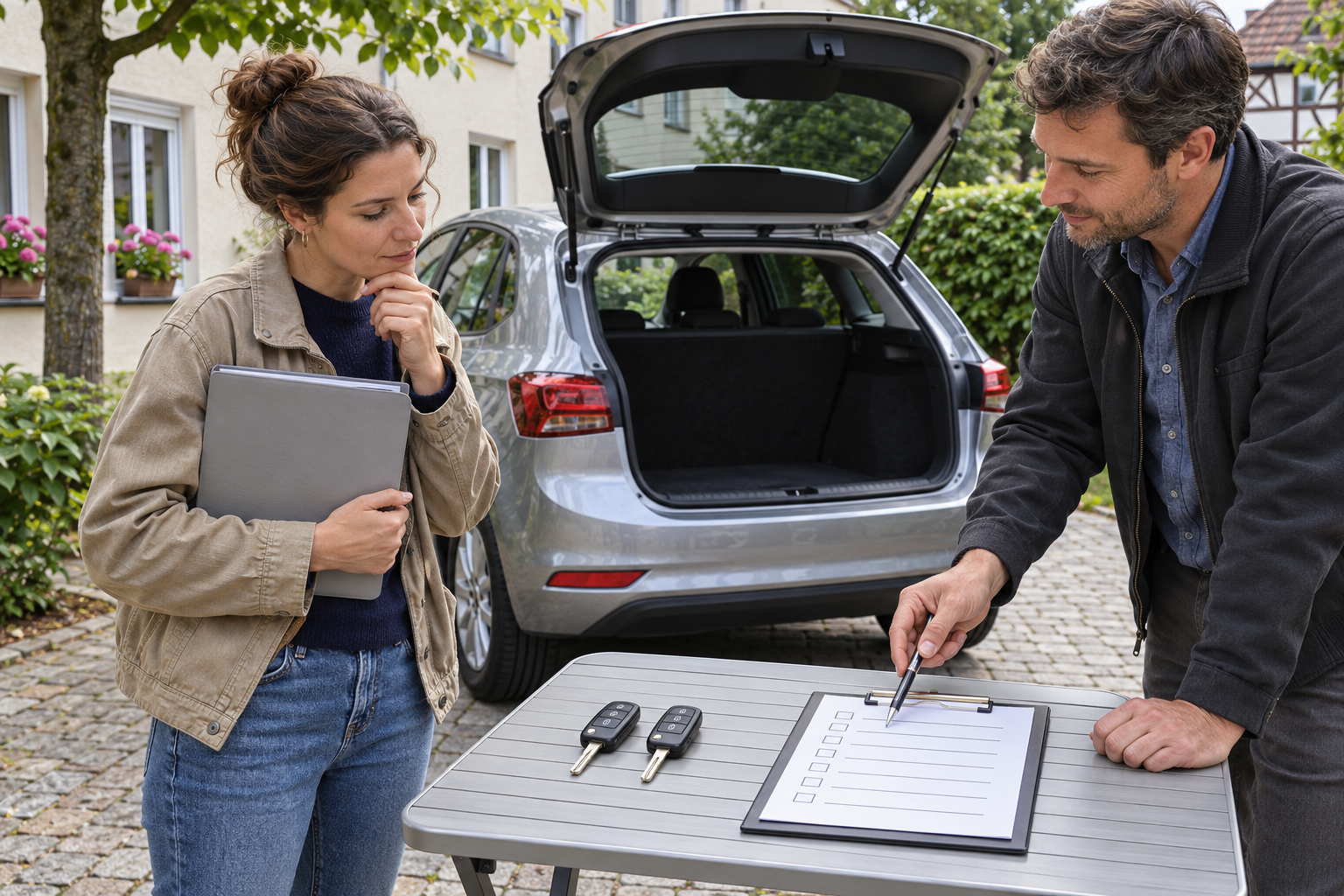
Prepare registration, insurance and vehicle tax
Agree who will submit each notification and which confirmation the other party will receive. Section 15(5) of Germany's Vehicle Registration Regulation, FZV sets duties to notify and update registration without undue delay following a keeper change. A private arrangement should support that process; it does not replace the required steps.
Ask your responsible German registration authority about its procedure and required documents. The Federal Service Portal describes registration changes using Bavaria, including vehicle documents, proof of insurance and a SEPA direct-debit mandate where applicable. Your authority's requirements for your particular procedure determine what you need.
An electronic insurance confirmation, called an eVB, supports the registration process. Separately establish with the insurer what cover applies to the test drive, handover and journey home. The sale must be notified to the insurer without undue delay under section 97 VVG, with section 122 VVG applying the rules to compulsory insurance. Ask how the timing works rather than inferring cover from the purchase contract.
For German vehicle tax, prepare the required vehicle information and requested SEPA mandate. After registration, check the tax assessment and payment details. The official vehicle-tax information on Hohe Börde's citizen portal explains the process through the registration authority and main customs office. Another car's tax amount is not a reliable figure for yours.
Choose the next step before committing
Continue preparing the purchase when the car and seller are clearly identified, material statements agree and outstanding technical questions have an agreed inspection route. The purchase decision then needs the actual findings. An inspection appointment is not a favourable inspection result.
Pause if authority to sell remains unclear, records contradict each other or an essential feature is only claimed. Name the missing answer precisely. You can then establish whether a document will resolve it, a specialist needs to inspect something or the candidate no longer fits your search.
If you have a specific advert and want to organise the next questions, use Vehilo's free First Look. It provides an initial read of the available details and useful seller questions. If a contractual provision or ownership position is legally disputed, that particular issue needs suitable legal assessment.
Questions before signing
Does “private sale” settle liability?
Consider the complete agreement and the seller's actual role. The label alone explains neither the scope of an exclusion nor possible exceptions. If individual promises conflict with the remaining text, have the wording clarified before completing the purchase.
Can I continue without a repair invoice?
Yes, provided you continue to treat the work as undocumented. Ask for other relevant evidence and decide whether an inspection can answer the material question. A missing invoice proves neither that a repair happened nor that it was omitted.
What does a signed distance reading mean?
That depends in part on exactly what is stated and agreed. Read whether it refers to the displayed odometer reading or a promised total distance travelled. Compare it with the history and resolve uncertainty before signing.
Should outstanding finance rule out the car?
Outstanding finance requires a clear settlement and release process. What matters is whether the responsible organisation and seller confirm arrangements you can follow. Without that basis, do not advance the contract and payment.
What should I keep after purchase?
Keep the advert, relevant messages, contract and attachments, payment evidence, handover record and vehicle documents together. Add subsequent registration confirmations and agreed records delivered later. This preserves which information came from each stage of the purchase.