Buying advice · 9 min · By Vehilo · ·
Used-car checklist: What to check before you buy
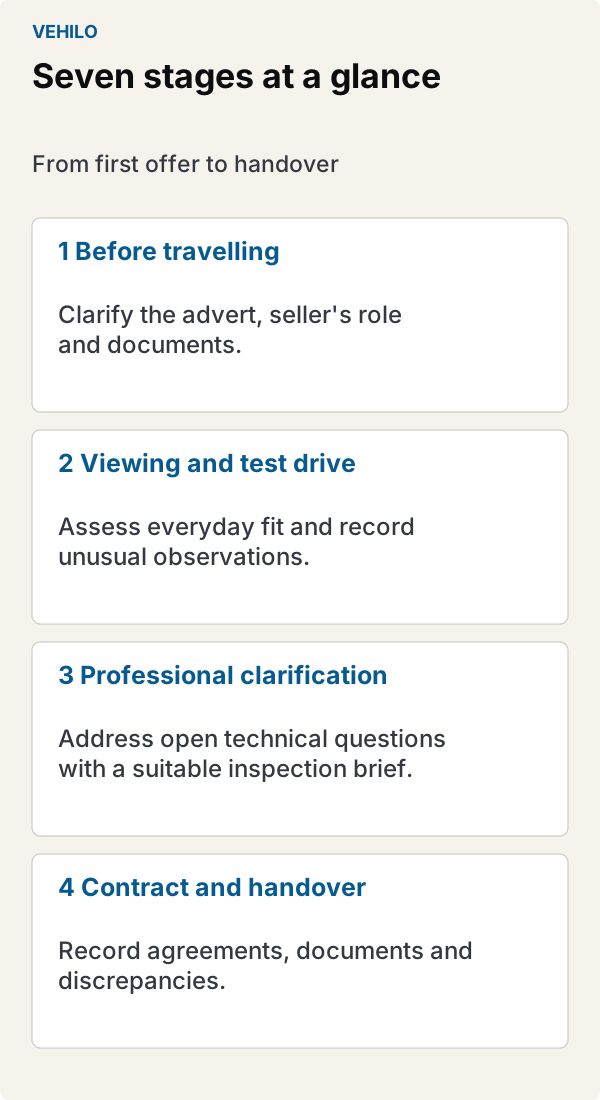
Start with your essential requirements. Follow seven stages: advert, seller and documents, viewing, test drive, professional inspection, contract and handover. Record the finding, evidence and next step.
Use this template from the first advert to handover. For each important point, record a finding: supported by evidence, unresolved, needs professional assessment or does not fit. A tick only means that you have addressed the point. It confirms neither the car's condition nor that it is accident-free.
First: What must this car do for you?
Before making first contact, write down three to five firm requirements. These might include seats, gearbox, space, towing capacity, charging access or a fixed purchase-price limit. Record preferences separately.
| Requirement | Importance | How can you establish this on the specific car? | Status |
|---|---|---|---|
| essential / important / preference | supported by evidence / unresolved / check / does not fit | ||
| essential / important / preference | supported by evidence / unresolved / check / does not fit | ||
| essential / important / preference | supported by evidence / unresolved / check / does not fit |
Attractive equipment does not make up for an unmet essential requirement. If you do not yet have a clear idea of which car to look for, start with a search plan. For a car you have already found, the checks begin with the advert.
1. Check the advert before arranging a viewing
- [ ] Note the exact model, engine, gearbox and, where applicable, battery version.
- [ ] Record the first registration, mileage, HU roadworthiness inspection date and stated number of registered keepers.
- [ ] Write down any stated damage, repairs, modifications and known defects.
- [ ] Clarify the seller's role: private seller, dealer or intermediary selling on a client's behalf.
- [ ] Note the price components, conditions and accessories included in the sale.
- [ ] Mark missing information as unresolved, not confirmed or disproved.
- [ ] Check whether the offer can meet your essential requirements at all.
- [ ] Compare the purchase price with your plan for inspection, transport, registration and foreseeable work.
Terms such as “documented servicing”, “new HU inspection” or “accident-free” are starting points for follow-up questions. The Vehilo listing-language decoder (German) shows what evidence might support these claims. For cost planning, you can use the first-year template. Missing amounts remain unresolved there; they do not become zero.
Decision after stage 1: If the car fails an essential requirement even on paper, you do not need a viewing appointment. If the only outstanding questions can be answered with evidence, ask them before travelling.
2. Clarify the seller and documents in advance
First ask for the information and documents relevant to this specific car. Personal documents do not need to be posted publicly for this.
- [ ] Clarify the name and role of the party you will be contracting with.
- [ ] Ask whether the seller and registered keeper are the same; clarify any difference and any power of attorney in advance.
- [ ] Request the current HU report, not just the date on the inspection sticker.
- [ ] Ask for the service book or a printout of the digital service history, along with matching invoices.
- [ ] Ask about known accident damage, repainting and any other previous damage.
- [ ] Request evidence for repairs or modifications specifically mentioned.
- [ ] For imports, rented batteries or special accessories, ask which supporting documents are available.
- [ ] Clarify whether a test drive and, if needed, an independent professional inspection are possible.
The guide to buying privately or from a dealer looks at the seller’s actual role and statutory rights concerning defects separately from the car’s condition.
ADAC recommends checking vehicle documents and service records, asking about accident damage, and matching the VIN and registration documents to the car. A promised document is not yet evidence you have checked. Read what it actually says when it is available.
Vehilo's guide to TÜV, service history and imports helps you put reports, entries and invoices in date order. It does not turn a gap into a proven defect.
Use specific questions in your message:
Before the appointment, could you please give me details of the exact version, the current HU report and the available service or repair records? What damage, defects or outstanding work are known? Who will be named as the seller in the purchase contract, and are a test drive and, if needed, an independent inspection possible?
Decision after stage 2: If the advert, answers and documents contradict one another, clarify the discrepancy before travelling. An unanswered question is not automatically a defect. It remains unresolved until a suitable answer or inspection is available.
3. Viewing: first match the car to the information
Arrange the appointment with enough light and no time pressure. If possible, take another person with you. DEKRA recommends someone who knows about cars; a second pair of eyes does not replace a technical inspection.
- [ ] Match the VIN on the car to the vehicle documents presented.
- [ ] Ask to see the original registration certificates, Parts I and II, and the HU report.
- [ ] Compare mileage readings and dates from HU reports, service entries and invoices in chronological order.
- [ ] Check the number of keys and the accessories promised.
- [ ] Look over the bodywork, glass, lights, tyres and interior.
- [ ] Look for visible differences in paint, panel gaps, fastenings or wear, and note anything unusual without turning those observations into a remote diagnosis.
- [ ] Watch the indicator lights and displays when switching the car on or starting it.
- [ ] Try all functions that matter to you: seats, seat belts, windows, climate control, infotainment, cameras, assistance systems and charging accessories, where fitted.
- [ ] Check whether your pushchair, dog crate, wheelchair, bicycles or other regularly needed luggage actually fit.
- [ ] Go through known defects and new observations with the seller.
TÜV NORD identifies bodywork, paint, interior, technical systems, brakes, lighting and assistance systems as typical areas to look at during a viewing. You do not have to turn what you see into a technical assessment. A visible concern can be enough to ask for an appropriate professional inspection before buying.
Decision after stage 3: If the car, documents and description do not match, pause the decision. Record the discrepancy and the evidence that could clarify it.
4. Test drive: record everyday suitability and unusual observations separately
Before driving, clarify permission, insurance, the excess and the test-drive conditions. Choose a route where you can safely experience situations relevant to your everyday use. ADAC recommends an agreement beforehand; TÜV NORD suggests city streets, country roads and motorways as possible elements where accessible and appropriate.
- [ ] Check the seating position, visibility, getting in and out, and ease of using the controls for yourself.
- [ ] Watch the displays and warning lights while driving.
- [ ] Pay close attention to the steering, brakes, gear changes or powertrain, and how the car tracks in a straight line.
- [ ] Note unusual noises, vibrations or smells, along with the situation and speed.
- [ ] Safely try the heating, air conditioning and important assistance functions.
- [ ] On a suitable route, check whether performance, comfort and space suit your everyday use.
- [ ] After the drive, check again for visible changes, warning messages or leaking fluids.
- [ ] Ask the seller about each unusual observation; record the answer and the next step promised.
The test drive answers two different questions: Does the car suit you, and does it show anything that needs closer examination? It does not prove that everything is in good working order.
Decision after stage 4: Do not bring an unexplained concern into price negotiations as though its cause were already known. Have it assessed by a professional, or continue to treat the cause and cost as unknown.
5. What a professional inspection should establish
Set out a specific inspection brief. “Please have a look at everything” is less useful than a list of vehicle details, observations and unresolved questions.
| Observation or unresolved question | Available evidence | What needs professional assessment? | Result / next step |
|---|---|---|---|
A professional inspection is particularly useful when safety-related components, expensive powertrain or battery systems, possible previous damage, modifications or contradictory documents are involved. Agree on its scope beforehand. An HU inspection, an approval mark, a battery certificate and a general used-car check may answer different questions.
For used electric cars, DEKRA recommends a professional check of technical systems, bodywork and electronic systems alongside documents, a test drive and a written contract. The same principle applies to other vehicles: choose the inspection to address the specific uncertainty, rather than treating a tick as proof that the car has no defects.
6. Before signing: turn unresolved points into decisions
- [ ] Check the final contracting party and the seller's role.
- [ ] Compare the vehicle details and VIN in the contract with the car and its documents.
- [ ] Record the agreed purchase price, payment method, handover time and accessories included in the sale.
- [ ] Record known defects, previous damage and specific assurances in writing.
- [ ] Record the scope and timing of any agreed work.
- [ ] Check whether any essential requirement remains unsupported or unmet.
- [ ] Include unresolved costs in your budget plan.
- [ ] Read the contract without rushing and obtain qualified advice on unclear legal questions if needed.
- [ ] Do not sign just because a seller is putting you under time pressure.
ADAC advises signing only after a viewing and test drive, and putting verbal assurances in writing. Your rights in an individual case depend, among other things, on the seller's role, the contract and the specific agreement. This checklist is not legal advice.
Decision after stage 6: The outcome is not “everything ticked off”, but one of four clear decisions: buy, decide only after further checks, request a new offer or walk away.
7. Document the handover fully
- [ ] Match the car and VIN to the contract once again.
- [ ] Record the agreed condition, mileage, fuel or charge level and any new observations.
- [ ] Take receipt of the registration certificates, Parts I and II, HU report, service documents and invoices, as agreed and available.
- [ ] Take receipt of all keys, operating manuals and agreed accessories.
- [ ] For electric cars, take receipt of charging cables and vehicle-specific battery or warranty documents where promised.
- [ ] Have both parties confirm the handover, payment and documents received in a way that can be checked later.
- [ ] Record and clarify any differences from the contract before completing the handover.
Keep the advert, messages, inspection records, contract and handover record together. This makes it possible to trace who supplied each piece of information and what was actually handed over.
Template to copy: your check record
Carry forward only the points that could change your decision. Do not use a score or offset an unmet essential requirement against several attractive extras.
All three rows in this example are entirely fictional.
| Fictional example | Status | Question or next step |
|---|---|---|
| “Documented servicing” in advert | Unresolved | Which work is documented with dates and mileage? |
| Repair claimed; invoice missing | Unresolved | Which record describes the work mentioned? |
| Five seats essential; papers show four | Does not fit | Pursue other candidates. |
| Stage / checkpoint | Your finding | Evidence or source | Unresolved question | Next step | Status |
|---|---|---|---|---|---|
| Advert | supported by evidence / unresolved / check / does not fit | ||||
| Seller / documents | supported by evidence / unresolved / check / does not fit | ||||
| Viewing | supported by evidence / unresolved / check / does not fit | ||||
| Test drive | supported by evidence / unresolved / check / does not fit | ||||
| Professional inspection | supported by evidence / unresolved / check / does not fit | ||||
| Contract | supported by evidence / unresolved / check / does not fit | ||||
| Handover | supported by evidence / unresolved / check / does not fit |
If you already have a specific advert, the free Vehilo First Look can help organise the visible information, missing evidence and suitable questions for the seller.
This checklist is based on publicly available guidance from ADAC, TÜV NORD and DEKRA, along with the linked Vehilo worksheets and guides. It was structured and written for Vehilo with AI assistance. Vehilo did not inspect a vehicle, conduct a test drive or assess an individual technical or legal case for it. The sources and public Vehilo pages were checked on 13 October 2026.