Vehilo explained · 6 min · By Vehilo ·
Before a used-car viewing: three questions that can prevent an unnecessary journey
Identify the open questions before travelling
Vehilo helps organise advert statements, missing evidence and seller questions. You can then decide what information is still needed before travelling and which inspection to arrange.
Without a model direction, Search Support provides reasoned directions, exclusions and a written search plan with criteria and filters. No advert is needed. If you have one, free First Look offers an initial read of that one advert.
For a broader checklist of issues to clarify before travelling, see the guide to red flags in used-car listings.
The example below is entirely fictional. It illustrates a method, not an advert reviewed by Vehilo or a customer case.
What the advert says, and what is missing
Suppose you want an automatic everyday car. The fictional description says “petrol, automatic, full service history” and mentions occasional jerking when pulling away. It omits the exact engine and provides no invoice for a claimed repair.
| Question | What the advert provides | What to establish before travelling |
|---|---|---|
| Does the specification fit? | Petrol and automatic are stated | Exact engine and gearbox from the vehicle documents |
| What work was done? | Servicing and a repair are described | Dates, mileage and the corresponding invoices |
| What explains the jerking? | A symptom is mentioned | Any workshop findings and access to an independent inspection |
None of these gaps identifies a particular defect. Equally, a good-looking advert does not resolve the symptom. It needs appropriate technical assessment.
A message with three specific questions
“Before planning the journey, could you clarify three things? What exact engine and gearbox does the car have? Can you provide the service records and invoice for the repair mentioned? Has a workshop assessed the jerking, and can an independent inspection take place before purchase?”
This is neither a remote diagnosis nor negotiation over a guessed repair bill. It establishes whether better information can support the next decision.
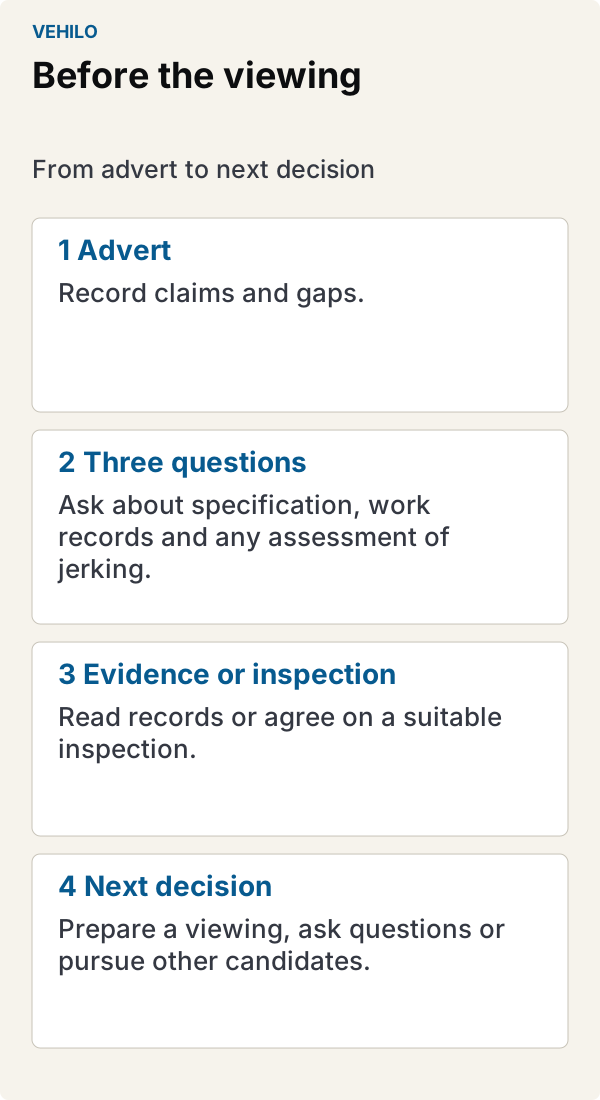
Use the answer to choose the next step
If the specification fails a firm requirement, an attractive price is not a reason to travel. If records arrive, read the work they actually describe: an invoice for another job does not answer the gearbox question.
For an unresolved symptom, arrange suitable qualified assessment before relying on it in a purchase decision. If the necessary inspection cannot be arranged, the uncertainty remains. That may justify postponing your decision; it does not establish dishonesty.
| Response to the fictional example | What it establishes | Your next step |
|---|---|---|
| The specification fails a firm requirement. | The car does not meet that part of your needs. | Continue with other candidates. A lower price does not change the requirement. |
| The records match the car and describe the repair mentioned. | You can trace the documented work; current condition still needs checking. | Arrange a viewing with the appropriate qualified inspection. |
| The specification is clear, but the jerking has no workshop assessment. | A material question remains open. | Request any existing findings or arrange the independent inspection before travelling. |
Use the document timeline to sort the invoices you receive. Obtain a vehicle-specific estimate for known outstanding work and record it separately from the asking price in your first-year budget. A symptom alone does not establish a reliable repair figure.
A viewing adds what the advert cannot provide: seating, controls, driving feel and the agreed technical checks. ADAC recommends viewing, a test drive and examining the documents before purchase.
Where Vehilo can help
First Look does not turn an advert into proof of condition.
You need not know everything before travelling. You should know which material question remains open and how it can be answered.